


 Billing Support
  Your Orders
  Your Quotes
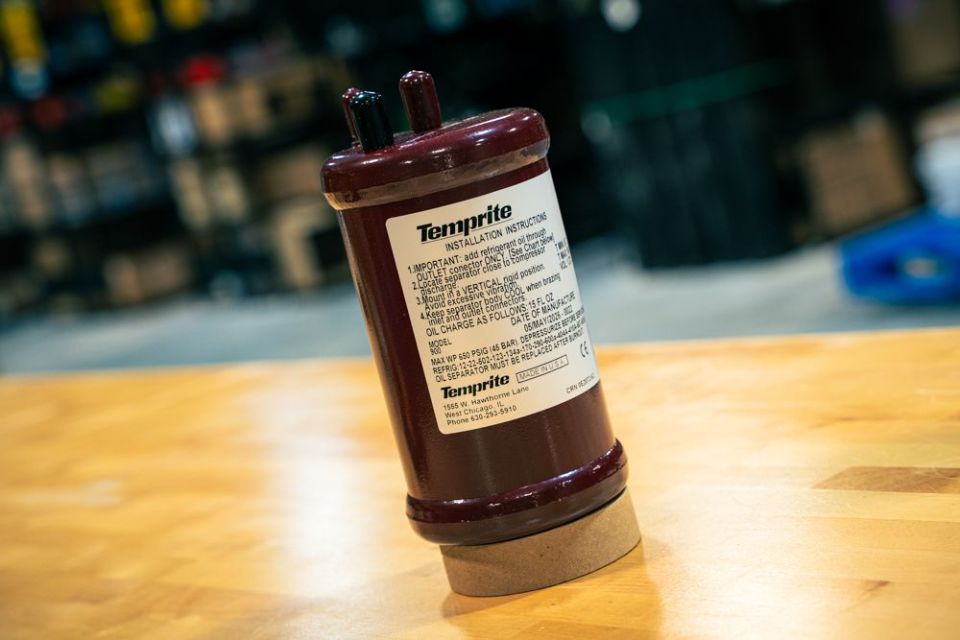
 What Is an Oil Separator? How Oil and Ammonia Separate in Industrial Refrigeration
Loading...
24 view(s)
You can’t run an ammonia refrigeration compressor without oil. And you can’t let that oil get loose in the rest of the system. Those two facts sit in permanent tension, and the oil separator is the component that resolves it.
Understanding why oil needs to be removed from the refrigerant stream — and how the different types of oil separators actually pull that off — is foundational knowledge for anyone working on industrial refrigeration systems. This post breaks down the chemistry, the physics, and the mechanical principles behind oil separation in ammonia refrigeration, from why the two fluids want to stay apart to how each separator design exploits that relationship to clean up the discharge gas before it reaches your heat exchangers.
Why Is Oil in the Refrigerant Stream in the First Place?
Oil doesn’t belong in the refrigerant circuit — but it gets there anyway. In any vapor-compression refrigeration system, the compressor requires lubrication to protect bearings, shaft seals, and the compression chamber from metal-on-metal contact. In screw compressors, oil also plays a direct role in sealing the compression chamber and removing heat of compression.
The problem is that no sealing arrangement is perfect. A small but continuous fraction of lubricating oil gets picked up by the high-velocity discharge gas leaving the compressor and carried downstream as a fine aerosol of oil droplets and vapor. As the IIAR notes, oil circulates through every component of the refrigeration system — which means the wrong oil, or too much of it, can cause problems throughout, not just at the compressor.
In oil-injected screw compressors, this carryover is particularly significant because large volumes of oil are deliberately introduced into the compression process for sealing and cooling. Screw compressors can discharge oil concentrations many times higher than a comparable reciprocating unit, which is precisely why they almost always require high-efficiency coalescing separators rather than the simpler inertial designs that work fine downstream of reciprocating compressors.
The Chemistry: Why Oil and Ammonia Don’t Stay Mixed
Think about oil and water. You can shake them together all you want, and the moment you stop, they split right back apart. Oil floats, water sinks, and neither has any interest in staying mixed. Ammonia and compressor oil behave exactly the same way — and that natural tendency to separate is the entire physical basis for how an oil separator works.
The reason comes down to how their molecules are built. Ammonia molecules have an electrical charge imbalance — one side of the molecule carries a slight negative charge, the other a slight positive charge. Oil molecules don’t have that. They’re electrically neutral throughout. Molecules with opposite charge imbalances attract each other and mix freely.
Molecules with nothing in common electrically don’t mix — they repel and separate. That’s why ammonia and compressor oil, when they collide inside the discharge line, don’t blend into a uniform fluid. They stay as separate substances bundled together by force, just waiting for the right conditions to pull apart.
This is worth noting because not all refrigerants behave this way. Some refrigerants — certain HFCs used in commercial systems — do mix with their lubricating oils and stay mixed. Those systems don’t rely on separation; they rely on keeping oil circulating with the refrigerant and returning it naturally. Ammonia doesn’t play that way.
Per the IIAR’s assessment of lubricants for ammonia refrigeration, conventional mineral and synthetic hydrocarbon oils don’t mix with liquid ammonia — they stay as two separate substances wherever they meet in the circuit. That means there’s no passive return mechanism. Oil that gets past the separator stays where it lands, coating surfaces and accumulating in low spots.
The oils used in ammonia refrigeration — primarily alkylbenzene and mineral-based lubricants — are specifically chosen because they hold up chemically against ammonia’s corrosive nature while still separating cleanly. Some specialty oils (PAG-type) do mix with ammonia, which has advantages in certain system designs, but most industrial ammonia refrigeration still runs on oils that separate. Which is exactly the point: an oil separator only works because the oil wants out of the ammonia in the first place. The separator just gives it the right conditions — slow the oil velocity, a surface to hit, and somewhere to drain.
What Happens When Oil Gets Downstream
The oil separator’s job is to intercept oil-laden discharge gas at the compressor outlet — on the high-pressure side of the system, where temperatures are high and oil is in an aerosol state. If it fails to do that job, or does it incompletely, the consequences compound through every downstream component.
Heat Transfer Degradation
Here’s the problem: oil is heavier than liquid ammonia, and unlike ammonia, it doesn’t boil. When it reaches the evaporator — the part of the system where ammonia absorbs heat and turns from liquid to vapor — the ammonia evaporates and leaves. The oil doesn’t. It stays behind and slowly coats the inside surfaces of the evaporator coils. Research on compressor oil removal shows that even a thin layer of oil on those surfaces acts like an insulating blanket — it slows down heat transfer, which means the system has to run longer and harder to hold the same temperature it was hitting easily before.
Left alone, that oil layer keeps building. The IIAR’s lubricant assessment documents that a thick enough oil film starts backing up pressure in the evaporator and blocking oil from finding its way back to the compressor — two problems that feed each other. Studies comparing systems with and without oil contamination have found efficiency losses of 15–28% and pressure increases of 36–60% in oil-affected systems. That’s not a rounding error. That’s the difference between a system running the way it was designed to and one that’s working overtime just to keep up — and the number-one thing standing between those two outcomes is a functioning oil separator.
Compressor Oil Starvation
Oil that migrates downstream, is oil that isn't sealing or lubricating the compressor. Left unaddressed, this means continuous oil replenishment requirements and, eventually, compressor starvation. Bearing wear, shaft seal failure, and compression chamber damage are all downstream consequences of chronic oil carryover combined with inadequate return.
System-Wide Contamination
Oil circulating through the system also contacts every valve, and component in the circuit. The wrong oil — or any oil at elevated concentrations — can cause deposit formation that plugs orifices and prematurely wears seals. As noted by Johnson Controls’ Director of Technology for Industrial Refrigeration, oil has a much bigger job than just lubricating the compressor, and problems from unproven or high-carryover oils show up throughout the entire system.
Where the Oil Separator Sits in the System
The oil separator is positioned on the high-pressure discharge side of the compressor — between the compressor outlet and the condenser inlet. This placement is deliberate. At the compressor discharge, the gas is hot and at high pressure, and the oil is in an aerosol state: a mixture of fine droplets (typically in the 1–10 micron range) and oil vapor.
This is actually the ideal point for separation. High temperature means lower viscosity oil that flows more readily once separated. High pressure means the density differential between oil and ammonia vapor is greatest, aiding gravitational settling. And intercepting oil here — before the condenser — means minimal oil enters the high-side liquid circuit or travels to the evaporators.
The separated oil collects in a sump at the bottom of the separator vessel. From there, it returns to the compressor via an oil return line. Per Bassett Mechanical’s overview of ammonia refrigeration systems, this return loop is what allows the compressor to remain properly lubricated while keeping oil concentration in the refrigerant circuit at acceptable levels.
How Different Types of Oil Separators Work
Oil separators don’t all work the same way. The design directly determines separation efficiency, appropriate applications, and maintenance requirements. There are four primary mechanical separation principles, and most real-world separators combine two or more of them.
Inertial / Impingement Separators
The simplest approach. The oil-laden gas enters the separator vessel and its velocity drops sharply inside the vessel. The kinetic energy that was keeping oil droplets suspended in the gas stream is removed. Heavier oil droplets can no longer remain airborne; they fall out of suspension, impact baffles or the vessel wall, and drain to the sump by gravity.
Direction changes add to the separation effect — gas flow can navigate a sharp turn, but oil droplets with higher inertia tend to continue in their original direction and impact a collecting surface. Inertial separators are mechanically simple, require no filter media, and are easy to maintain. Their limitation is efficiency: separation rates typically top out around 65%, and they’re less effective at capturing the fine oil mist that screw compressors produce.
Coalescing Separators
The highest-efficiency mechanical design, and the standard for oil-injected screw compressors. Discharge gas passes through a fibrous filter medium — typically made of materials resembling fiberglass or metal mesh — where sub-micron oil droplets that are too small to separate by gravity or centrifugal force are captured by collision with fiber surfaces. Once attached to a fiber, droplets grow by collecting additional droplets (coalescence), until they’re large enough that gravity pulls them down to the sump.
The coalescing mechanism works from the inside of the filter outward — oil concentration in the media increases from inlet to outlet face. According to RETA Industrial Refrigeration Course 1, “Highly effective coalescing elements are also available that will provide oil separation to as low as 0.1ppm.”An important operational note: coalescing elements require minimum gas velocity to function correctly — too slow and fine oil mist passes through the filter without contacting the fibers. They’re also a service-replacement component, not cleanable, because washing destroys the fiber structure that makes separation possible.
Separator Type Comparison
Use this reference when evaluating which separator type is appropriate for a given application.
|
Type |
How It Works |
Best For |
Separation Efficiency |
|
Inertial / Impingement |
Slows gas velocity; oil drops fall by gravity and direction change |
Reciprocating compressors, lower-pressure systems |
~65% |
|
Washing (Bubbling) |
Discharge gas bubbles through liquid ammonia; oil captured in liquid layer |
Traditional ammonia systems, large reciprocating compressors |
85–90% |
|
Centrifugal / Cyclone |
Spiral flow throws oil outward by centrifugal force; drains to sump |
Screw compressors, high-flow systems |
90–95% |
|
Coalescing (Mesh/Packed) |
Fine media merges micro-droplets into large drops that drain by gravity |
Screw compressors requiring precision oil control |
Up to 99.5% |
|
Combined |
Multiple principles in sequence (inertial + centrifugal + coalescing) |
High-efficiency industrial systems |
Up to 99.5% |
Frequently Asked Questions
What is an oil separator in a refrigeration system?
An oil separator is a vessel installed in the high-pressure discharge line between the compressor and the condenser. Its function is to remove compressor lubricating oil from the refrigerant vapor before that vapor enters the condenser and heat exchanger circuit. Oil that makes it past the separator degrades heat transfer efficiency, accumulates in evaporators and low-side vessels, and over time contributes to compressor oil starvation. The separated oil is returned to the compressor crankcase through an oil return line.
Why doesn’t oil just dissolve into ammonia?
Because ammonia is a polar molecule and most lubricating oils are nonpolar — and polar and nonpolar fluids are immiscible. They form separate phases rather than a true solution. This is the same reason oil and water don’t mix. Some specialty lubricants (certain PAG oils) offer miscibility with ammonia, but the conventional mineral and alkylbenzene oils used in most ammonia systems phase-separate readily. For a deeper look at ammonia-lubricant compatibility, the IIAR’s lubricant assessment is the most authoritative technical reference.
What happens if an oil separator fails?
Oil migrates downstream into the refrigerant circuit. In the short term, it coats heat transfer surfaces in the condenser and evaporators, reducing system efficiency and increasing operating pressures. Over time, oil accumulates in low-side vessels and evaporator circuits where it doesn’t boil off — reducing capacity and requiring periodic oil draining. Simultaneously, the compressor begins losing oil and may eventually experience lubrication-related bearing or seal failure. Both effects compound: the system works harder while becoming progressively less capable.
How much oil actually ends up in the discharge gas?
It depends heavily on compressor type and design. Reciprocating compressors typically discharge oil concentrations in the range of 50–80 ppm with a simple inertial separator downstream. Oil-injected screw compressors discharge at much higher concentrations, which is why they require coalescing separators with efficiency ratings up to 99.5%. Even residual concentrations of a few ppm in the refrigerant circuit will eventually cause measurable fouling on evaporator surfaces given enough system operating hours.
Where can I source oil separator parts and units?
Keep Supply stocks oil separator components and complete replacement units from OEM-aligned brands for ammonia, CO₂, and halocarbon refrigeration systems. Search the product catalog at keepsupply.com or contact your rep directly for part number confirmation and availability.
Need oil separator parts or a replacement unit?Keep Supply stocks oil separator components and complete units from trusted OEM brands — for ammonia, CO₂, and halocarbon systems. |
This content is provided for informational and educational purposes. Always consult manufacturer documentation, applicable IIAR standards, and ASME codes before modifying or servicing pressurized refrigeration equipment.

Login into your account
New Customers
Creating an account has many benefits:
- See order and shipping status
- Track order history
- Check out faster
Comments were not found


